Local Press Coverage
Applied Motion Systems is recognized for growth and excellence

Making the most of motion
Sunday, November 7, 2004
By JULIA ANDERSON, Columbian staff writer
The first hint Ken Brown's parents got that their son would be a mechanical engineer was when at age 8 he "disassembled" the family's garden tractor.
"Under duress, I put it back together," remembers Brown, founder and president of Applied Motion Systems Inc., a Vancouver company that is helping improve efficiency in some of America's most basic industries paper, glass and packaging.
Brown, along with Ken Goheen, vice president for engineering, and their team are marrying automated motion-control technology with traditional mechanical processes that allow companies such as Saint Gobain to make beer bottles faster, Georgia-Pacific to produce paper towels more efficiently, and Weyerhaeuser to cut lumber more quickly and precisely.
Customers also include heavy hitters such as Intel, Sonoco Products, Hewlett-Packard, Boeing and a Hollywood video-equipment company.
Last spring, Applied Motion designed and built a semi-automated, rail-mounted camera system and controller console used at the Academy Awards presentation. The equipment allowed camera crews to bring sweeping motion to the video coverage with less hassle.
"The same laws of physics apply in all these cases," said Brown, who earned his mechanical engineering degree from the University of Washington in 1990. "We're an integrator. We provide the control systems that run machines more efficiently with less maintenance and down time. That's our core strength."
As U.S. manufacturing businesses fight to reduce costs in the face of serious global competition, Applied Motion and companies like it are gaining importance.
At least two other small Vancouver businesses operate in the same arena.
"It's a very timely thing," said Steve Nylund, president of Delta Computer Systems, Inc. in Vancouver, which produces motion-control devices that are used by companies such as Applied Motion. "The dollar value of goods manufactured in this country hasn't really dropped even though we've seen a decline in manufacturing jobs. Automation is in the thick of where manufacturing is going."
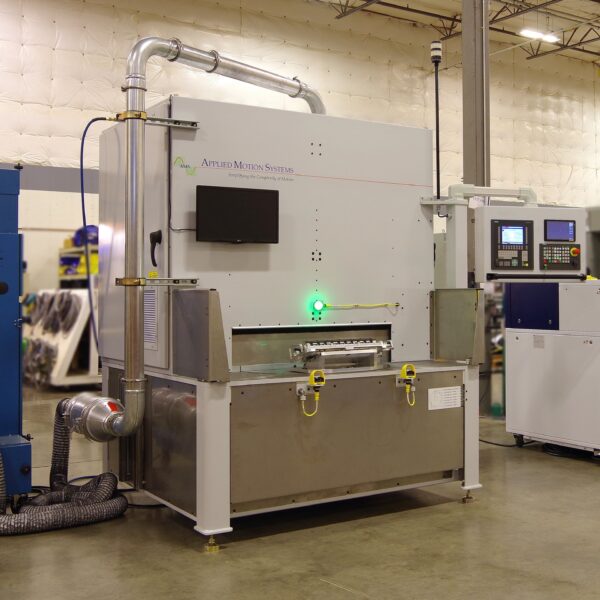
Using the marketing slogan, "Simplifying the Complexity of Motion," Applied Motion produces computer-controlled mechanisms that mimic cam-driven machinery. The beauty of the new technology is its simplicity: no cams to change out, less down time. An operator can pull up a new computer setting and adjust a machine's function, even on the fly.
For manufacturing companies looking for ways to cut operating costs as much as 30 percent to 50 percent, such machines can make a huge difference and may be contributing to the jobless recovery in heavy industry.
Rapid expansion
By several criteria, Applied Motion Systems is wildly successful. Corporate revenue has been growing at an annual average rate of 43 percent. The company's client base continues to expand as it also builds business with a core group of repeat customers.
Employment is up from four people in 1997 to 22, with plans to add more in the next 12 months.
A year ago the operation moved out of Yacolt, where Brown launched the company in 1996, and into a two-story 27,000-square-foot headquarters at 12000 N.E. 60th Way in Orchards.
Brown and Goheen describe their business strategy as "careful and cautious."
Only in the past year have they added accounting and marketing people to their executive business team.
"This has been an earn-as-you-go operation," Brown said. "It took me a year to write myself a paycheck. In 1998, we had 13 employees and grossed $3.2 million. We were completely over our heads. We didn't know how much money we had or whether we could spend it."
The two pulled in their horns and waited out the Y2K computer bug transition, then again began building business.
Early collaboration
Brown and Goheen, both 41, have known each other since their early 20s, when they were roommates.
Goheen has an electrical engineering degree from Oregon State University and spent 10 years working for Boeing on the engine-control system for the 777 airplane.
Brown put himself through the UW engineering program while working full time, including stints on Alaskan fishing boats.
His first professional experience came as a co-op student at The Robbins Co., where he helped integrate mechanical equipment and computers used to dig the English Channel tunnel project.
Brown then spent three years at Anderson Controls, a Kent-based control system supplier, until he burned out from 80-hour weeks.
"In the fall of 1995, my wife and I sold everything and moved in with her parents in Yacolt," Brown said. "I was going to buy a bulldozer and do contract work."
Then a prior work connection produced the opportunity for Brown to design the controls for a can ring-lid process for Sonoco Products Co.
His high-speed automated system for putting a Pringles-style lid on food cans became Applied Motion's first success. The lid system doubled Sonoco's production speed while lowering materials cost.
Applied Motion has brought the same efficiencies to paper converting, veneer board processing, machine tool controls, glass container manufacturing and wood products manufacturing. Saint Gobain, among the world's largest producers of glass beer bottles, was another early customer.
Rented garage
Brown did his first work in a rented Yacolt garage, then as other business developed, he moved into downtown space in a former auto repair shop.
"From there things took off, completely by word-of-mouth," Brown said.
His early collaboration with Goheen seems to be a key aspect of the company's success.
"I come up with the ideas, the core technology … and kind of write software programming by the seat of my pants," Brown said. "Ken takes my work, refines it, makes it run well."
By 1998, the company had contracts with HP to build a robot for stacking printers and Trus Joist for improving its wood products manufacturing systems. Saint Gobain hired the company to provide control systems to run machines that make glass bottles.
By 2002, Applied Motion had maxed out in its Yacolt building and was turning down business.
The new Orchards site, which features a open, two-story manufacturing and assembly space, has broadened business opportunities.
Georgia-Pacific shipped one of its Camas paper towel converting machines to the company so Applied Motion engineers and fabricators could retrofit control equipment.
Applied Motion has designed a control system for glass vitrification at a nuclear-waste plant in South Korea.
Managing growth
Since the move from Yacolt to Orchards, Applied Motion has been adding a new employee about every two months.
"We're now learning how to empower people," Brown said. "It's a struggle, because customers still want to talk to Ken and me. But we're trying to development more experts inside our organization."
A year ago, Keith Upkes, a Vancouver accounting consultant, joined the company as controller. Herb Johanson was more recently hired as director of marketing. More electrical and mechanical engineers are on board.
"We've formed a management team and meet weekly to argue about how we're going to run this company," said Brown, who still lives in Yacolt with his wife and five children.
The company expects to surpass this year's revenue goal of $5 million.
Growth is bringing plenty of new challenges.
Patent litigation is a lurking threat. To avoid such problems, the company is diligent about researching its newest technologies, said Brown. And the company is working hard to find employees who fit its workplace culture.
"Our vision is not something you can teach," Brown said. "It has to do with character, attitude toward work."
The company is moving forward on several fronts.
This month, a marketing team will participate in an industrial trade show in Germany to test the international market.
The trip is part of an overall strategy to build repeat business, particularly in the glass manufacturing sector while attracting customers.
With everything going more or less according to plan, Applied Motion expects to see 20 percent revenue growth next year.
"We seem to have caught the attention of some of the bigger Fortune 100 companies," said Johanson.
"With pressure on manufacturers worldwide to increase efficiencies in the face of competition from China, it appears Applied Motion Systems will be busy for some time to come."
Julia Anderson is The Columbian's business editor. To reach her, call 360-759-8071, or send email to julia.anderson@columbian.com.
Copyright © 2004 by The Columbian Publishing Co. P.O. Box 180, Vancouver, WA 98666. No part of this publication may be stored in a retrieval system, transmitted, or reproduced in any way, including but not limited to photocopy, photograph, magnetic or other record, without the prior agreement and written permission of the publisher.